WINGFOIL
GUIDE
FROM THE BEACH TO INDEPENDENT FLIGHT
The theory half of learning to wingfoil, written the way it is actually taught in Mui Ne — in the order you will meet it, with the evidence that explains why.
The theory half of learning to wingfoil: the wind, the wing, the board, the foil, the rules and the emergencies, written so your instructor can spend the lesson on the water rather than on the sand.
A syllabus replacement, a certification, or a substitute for supervised water time. No part of this guide qualifies anybody to fly a foil unsupervised.
Every safety-critical statement traces to a training body, a national governing body, the sport’s own association, a current manufacturer manual, or the one published study of wingfoil injuries. Where the sources disagree — and on the board leash they do — this guide shows the disagreement rather than picking a side quietly.
CONTENTS
- PART ABEFORE THE WATER
- 00START HERE
- 01WING VERSUS KITE
- 02THE WIND
- 03THE SPOTAWAITING LOCAL DATA
- 04THE WINGAWAITING LOCAL DATA
- 05THE BOARDAWAITING LOCAL DATA
- 06THE FOILAWAITING LOCAL DATA
- 07THE LEASH QUESTIONAWAITING LOCAL DATA
- PART BON LAND
- 08RIG AND CHECKAWAITING LOCAL DATA
- 09WING HANDLING ON LAND
- 10NEUTRAL, POWER AND SHEETING
- PART CON THE WATER, NOT YET FLYING
- 11IN AND OUT OF THE WATERAWAITING LOCAL DATA
- 12KNEES, THEN FEET
- 13TAXIINGAWAITING LOCAL DATA
- 14STEERING AND HOLDING GROUNDAWAITING LOCAL DATA
- PART DFLIGHT
- 15WHY THE BOARD FLIES
- 16THE FIRST FLIGHTAWAITING LOCAL DATA
- 17HEIGHT CONTROL
- 18SUSTAINED FLIGHT
- 19GOING UPWINDAWAITING LOCAL DATA
- 20TURNING ROUND
- PART EJUDGEMENT
- 21FALLING
- 22SELF RESCUEAWAITING LOCAL DATA
- 23RIGHT OF WAYAWAITING LOCAL DATA
- 24WHEN NOT TO GO
- 25CHOOSING YOUR OWN EQUIPMENTAWAITING LOCAL DATA
- PART FMUI NE & INDEPENDENCE
- 26WINGFOILING IN MUI NEAWAITING LOCAL DATA
- 27THE PROGRESSION MAPAWAITING LOCAL DATA
- 28THE INDEPENDENT WINGFOILERAWAITING LOCAL DATA
- 29GLOSSARY
START HERE
This is the theory half of learning to wingfoil. The other half only happens on water, with somebody watching you.
WHAT YOU WILL BE ABLE TO DOSay what this guide can teach you and what it cannot, and find yourself on the five gates.
Wingfoiling is two sports learned one after the other. First you learn to hold a wing and make a board go where you want. Then, separately, you learn to fly. Almost everything that is confusing about the first week comes from not knowing that yet.
The essential path
This guide is thirty chapters long because the sport has thirty chapters in it. You do not have to read them in order, and you do not have to read them all before your first lesson. If you read nothing else, read these nine.
How to read the four marks
Every instruction in this guide carries one of four marks. They are not decoration. They tell you whether you may act on what you have just read.
- KNOWSafe to read and act on.
- WATCHWhere this goes wrong.
- DANGERInjury, not inconvenience.
- INSTRUCTOR CHECKDo not attempt unsupervised.
- LOCAL NOTEMui Ne specific, and only where verified.
Three things that are true before you start
- You must be able to swim. IKO requires “minimum swimming ability” for its wing course. Duotone requires that you are a good swimmer and wearing a life jacket. Naish requires an experienced swimmer. This is not a formality.
- Never permanently attach yourself to the wing. Your leash is a connection you can break in under two seconds, and you should have broken it once, deliberately, before you ever need to.
- Never go further from shore than you could swim back. Two separate manuals in the register state this in almost the same words, and neither of them is being lawyerly.
Where you are going
This guide is built around five gates. A gate is passed by demonstrating something, not by spending an hour — and this guide’s gates are C2SKY’s own, informed by established training frameworks rather than taken from any of them. The structure is not a stylistic choice. The one published study of the sport reports that injury rates were significantly associated with experience — they fell as experience rose — and that riders themselves attributed more than three quarters of their injuries to riding errors when tired. A ladder counted in hours rewards staying on the water. A ladder counted in demonstrated skills does not.
What this guide will not do
It will not tell you how many hours it takes to fly. Nobody honest can, and C2SKY has not published a general claim. It will not print a number it cannot source. Where the training bodies and the manufacturers genuinely disagree — and on one important question they do — it will show you the disagreement rather than pick a side quietly.
WING VERSUS KITE
A friendlier thing in your hands, and a much less friendly thing under your feet. That is the trade, and it is worth understanding before you choose.
WHAT YOU WILL BE ABLE TO DOSay honestly what each sport asks of you, and choose between them for the right reason.
Most people arriving in Mui Ne have already decided, or think they have. The decision is usually made on how the two sports look. It is better made on what they do.
What changes in your hands
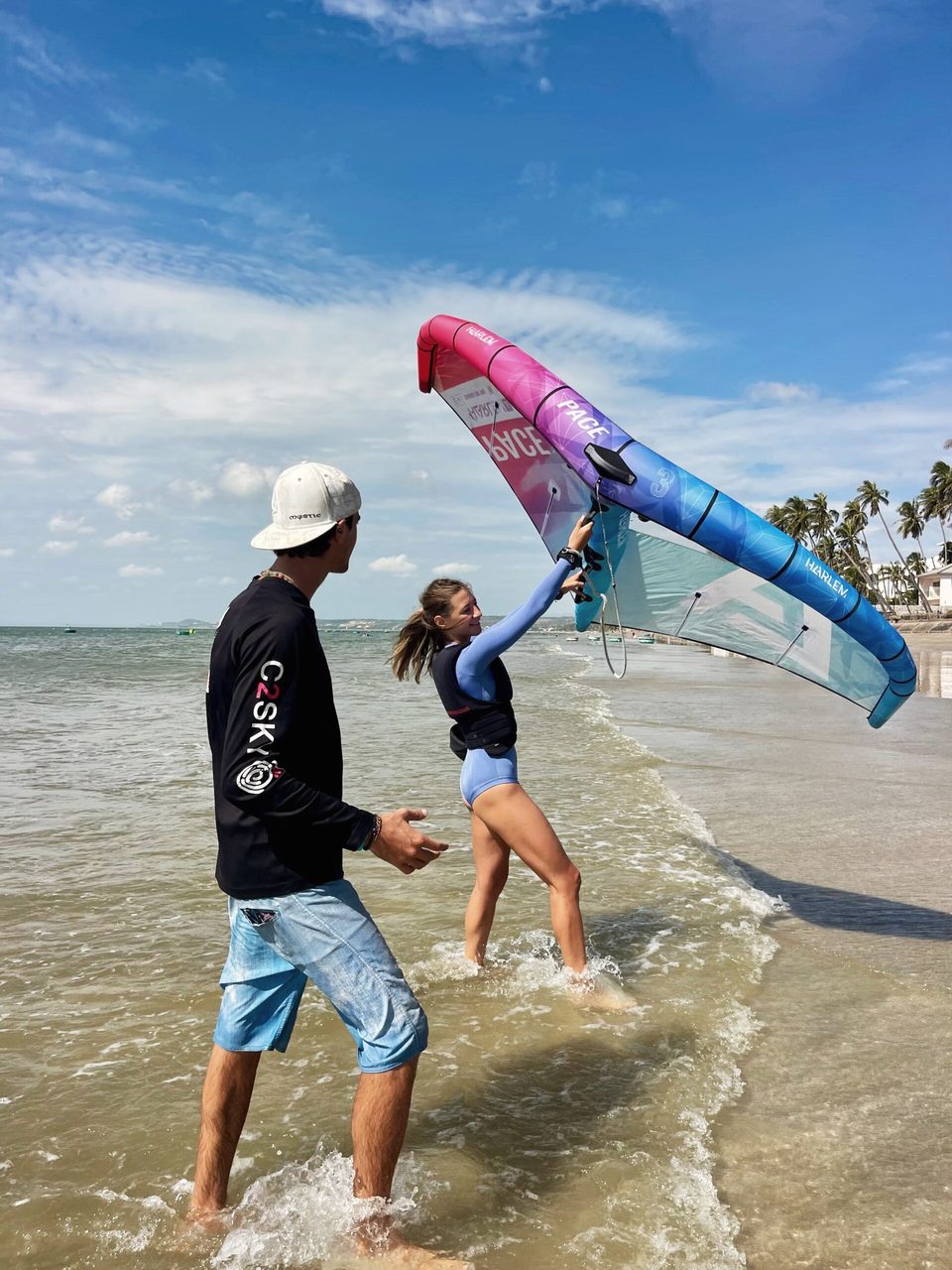
A kite flies on lines, in a window, twenty metres above you, connected to a harness through a release system you must be able to find and operate under load. A wing is held. There is no window, no bar, no chicken loop, and no line tension to manage. If a wing is hurting you, you let go of it, and it stops. That single sentence is the reason the first day is calmer.
What changes under your feet
A hydrofoil. It is rigid, it is fast, it stays sharp because a thin trailing edge is what makes the section work, and you will fall onto the water directly above it many times in your first sessions. The hazard has not gone away. It has moved from above you to below you, and from cloth to carbon.
What the numbers say
There is exactly one published study of wingfoil injuries: 415 riders, twelve months, self-reported. It found an injury incidence of 5.7 per thousand hours — against 5.2 for windsurfing and up to 10.5 for kitesurfing. On that evidence the exchange is a favourable one.
But the shape of the risk moves as well as its size. In kitesurfing a large share of the serious incidents happen on the beach, launching and landing, with an object overhead. In wingfoiling 99.15 % of the injuries happened on the water, and the mechanism was almost always the rider’s own equipment.
What changes in the learning curve
C2SKY’s own published answer to this question is the honest one, so here it is unedited: “Wing has a gentler first day — the wing depowers by letting go — and a longer road to foiling. If you want to be riding in a week, kite is faster; if you want the calmer learning curve, wing.”
THE WIND
Winging works from about five knots. Flying needs ten to fifteen. And once you can fly, you need less wind than you did to start.
WHAT YOU WILL BE ABLE TO DOSay how much wind each half of the sport needs, and which directions are teachable.
Wingfoiling has two wind requirements, not one, and the relationship between them surprises almost everybody.
Two numbers, from a national governing body
The RYA publishes both. Wingsurfing — the board without a foil — works from “as little as 5 kts”, with about fifteen knots as a sensible beginner ceiling. Getting onto the foil needs “about 10–15 kts initially”, and as your technique improves you can fly in less and stay out in more, up to about twenty-five knots.
The reason is in Chapter 15. A foil has to reach a take-off speed before it lifts anything, and until it does you are pushing water. Once it lifts you, the drag collapses and almost nothing is holding you back — which is why the wind needed to stay flying is far less than the wind needed to start flying.
The five directions
Wind direction relative to the beach decides more about your day than wind strength does. Read the figure with one thing in mind: only the offshore verdict comes from the manufacturers. The rest is this guide reading across sources that do not entirely agree, and the figure marks which is which.
Offshore — the one every source refuses
Cross-offshore — the guide’s own reading
Direct onshore — where the sources part company
Cabrinha says avoid onshore as well as offshore. Duotone says be careful with it. Naish forbids only offshore and says nothing about onshore at all. This guide does not turn Cabrinha’s position into a universal prohibition, because two of the three others do not hold it. Direct onshore is ridable, and it is a distinct risk class rather than a milder version of offshore: the wind is pushing you toward the hazard rather than away from it. Everything that goes wrong ends up on the beach — you, your board, the shore break, and whoever is standing in it — and on a foil the water gets shallower in exactly the direction you are being pushed. Getting off the water is easy. Getting off it in one piece, at speed, with a foil under you, is the part to think about.
Cross-shore and cross-onshore
Cross-shore blows along the beach: what you drop drifts along it rather than out to sea or into the shore break. Cross-onshore — angled onshore, which is what Mui Ne has — is what every source implicitly leaves as the good case, and it is the one this guide calls best for a learner: enough onshore component that you and your equipment come back, enough cross component that you are not being driven straight into the beach.
Gusty is worse than strong
Every manual separates the two, and they are right to. A steady twenty knots is a wing size decision. A gusty twelve to twenty-two is a series of surprises, and a surprise is what a beginner has no answer to. Duotone’s wording is the one to remember: never use a wing in wind so strong that you cannot maintain precise control.
A forecast is not a measurement
A model tells you what it expects. A station tells you what is happening. C2SKY keeps the two apart everywhere on its own website and this guide does the same. If there is no measured reading to give you, the honest answer is the camera, not an invented figure.
THE SPOT
A foil asks one thing of a beach that nothing else does. It asks how deep it is.
WHAT YOU WILL BE ABLE TO DOAssess a wing spot before you touch any equipment, and say what a foil needs that a board does not.
You will be taught a spot assessment on your first day. This chapter is what it is for.
Depth is the new question
Every other board sport asks whether the water is deep enough to fall into. A foil asks whether it is deep enough to fly in. The RYA’s guidance to its own training centres puts it in one line: “Consideration should be paid to the depth of water due to the foil lengths.” Naish’s foil manual asks you to be aware of “how deep your foil extends”. Duotone simply says do not use the foil in shallow water.
Space, in three directions
Foiling craft are fast, and a beginner uses more water than they expect. The RYA is specific about the shape of the area rather than its size: “Beginners require space across the wind as well as downwind.” A teaching area is a box, not a line.
Flat water, if you can have it
“Flat water is a preference and should be a priority wherever possible” — the RYA again, and F-One’s spot advice agrees: favour water that is not choppy or turbulent, with enough depth and without reefs or shoals. Chop does not stop you learning. It makes every hour of it harder than it needed to be.
The five questions, in order
- 01
Where is the wind coming from?
Not roughly. Relative to the beach, and therefore which of the five directions from Chapter 02 you are standing in.
COMMON MISTAKEReading the flags at the hotel rather than the water.
- 02
How deep is it, and how far out is it deep?
Foil depth plus a margin, for the whole area you intend to use — not just where you get on.
COMMON MISTAKEAssuming the deep bit you can see extends to where you will land.
- 03
How much room is there, across the wind and downwind?
And where does it stop. A downwind limit briefed before you go out is standard practice at a training centre.
COMMON MISTAKEOnly looking at the water directly in front of you.
- 04
What is downwind of me?
Because that is where you end up. Rocks, moorings, fishing gear, a headland, a shipping lane, a swimming area.
COMMON MISTAKEDiscovering it on the way past.
- 05
Who else is here, and where will I get out?
Naish’s manual asks for 100 m from obstructions. F-One’s exit rule is that you get off the board at the same distance from shore that you needed to get on.
COMMON MISTAKERiding all the way in.
THE WING
An inflatable skeleton, a piece of cloth, and two hands that do two different jobs.
WHAT YOU WILL BE ABLE TO DOName every part of a wing using the words your instructor will use, and say how it makes power and how it sheds it.
A wing is a sail you hold. It has no lines, no bar and no fixed attachment to you except a leash. Everything it does, it does because of the angle you hold it at.
The inflated part is the skeleton
The leading edge and the strut are inflated tubes. They are what makes a piece of cloth hold a shape in the wind, and they are also what makes the wing float when you are lying next to it in deep water. Everything else — canopy, window, tips — is fabric.
The front hand is the angle, the back hand is the throttle
The front hand sets where the wing sits relative to the wind. The back hand sheets: pull it in and the canopy takes a bigger bite of the wind and the power rises; let it out and the power goes. It is continuous, not a switch, and learning to use it as a dial rather than a grip is most of the first hour.
Neutral feels safe and is not
Held overhead, a wing feels stable and feels like it is doing nothing. Cabrinha’s own glossary is blunt about what that position actually is: it “is also the position in which on land the rider is most susceptible to lofting”, and the manual’s instruction is to make your way to the water without delay rather than stand there.
Flagging is the off switch
Take one hand to the leading edge, let everything else go, and the wing weathervanes. It points itself downwind and produces almost nothing. This is how you walk with it, how you rest, and how you make it stop being a problem while you deal with something else.
A wing on the ground is a wing that can leave
Sizes
A beginner is usually on something between 2.8 and 4 square metres, which is the RYA’s published range. What size you are handed on the day is a function of your weight, the wind, and what the school has. Chapter 25 is about choosing your own.
THE BOARD
Volume is flotation, flotation is learning time, and nobody agrees on how much you need.
WHAT YOU WILL BE ABLE TO DOSay what board volume buys you, and read a sizing chart critically.
A wing board is not a surfboard and not a kiteboard. It is closer to a small paddleboard with a foil bolted underneath, and the first thing it has to do is float you while you are stationary and getting things wrong.
What volume buys
Every litre of volume is a moment in which the board is holding you up instead of you holding yourself up. On a board you can kneel and stand on while it is stationary, you get to learn the wing without simultaneously fighting the board. On a board that sinks under you, you learn both at once, badly.
The published rule, and the published disagreement
IWO — the wingfoil certification body — publishes the only rider-facing sizing rule any certification body publishes: your weight in kilograms plus forty, in litres. A seventy-kilogram rider, about 110 litres. The same article also publishes level bands, and they are wider than the formula, and they overlap.
And the RYA starts somewhere else entirely
The RYA’s beginner route does not use a wing board at all at first. Its published advice is a large-to-medium-volume windsurf board with a centreboard, or a WindSUP, with no foil on it. That is a legitimate disagreement about method, and it is the same one you will meet again in Chapter 16.
Foot straps
Straps hold the board to you for riding and for jumping. They also hold your foot in place during a fall, and the study puts a number on that: straps caused 6 % of knee injuries and 24 % of ankle injuries by holding the foot as the rider went down. The paper’s authors observe that the fix — a strap that opens only in a fall — does not exist yet.
It is heavy, and it does not behave like a board
With a foil fitted, the whole assembly is heavier, more awkward and much less forgiving on land. It has to be laid on its side; stood up or turned over it falls, and either it damages itself or it damages somebody. That is in F-One’s manual as an instruction, not a tip, and Chapter 11 is about it.
THE FOIL
Four pieces of carbon that turn speed into height. It is why the sport exists, and it is the thing that hurts people.
WHAT YOU WILL BE ABLE TO DOName every part of a hydrofoil, say what each does to the ride, and describe exactly why it is dangerous.
The foil is the reason a wingfoiler keeps going in wind a windsurfer would give up in, and it is the reason this guide has a chapter about falling.
Four parts
The mast holds everything down in the water and sets how high you can fly. The fuselage holds the two wings at a fixed distance and angle. The front wing makes the lift. The stabiliser — the small one at the back — holds the attitude, and is the part your feet find.
How it flies, in the manufacturer’s own words
“The front and rear wings work as lifting devices, which means they can create a lifting force from the flow of water that travels across them at speed. This is the reason why they are built with a specific sectional profile.” That one sentence governs Chapters 15 to 20.
Area sets your take-off speed
Lift rises with speed and with area, so a bigger front wing reaches the lift you need at a lower speed. The RYA states the consequence directly in its teaching guidance: “The larger the surface area of the front wing the earlier the flight in lighter winds.” Bigger is easier to learn on and slower at the top end. That is the whole trade.
Aspect ratio sets forgiveness
A low-aspect front wing is short in span and thick in section: stable, early to lift, and tolerant of a rider who is not yet smooth. A high-aspect wing is long, thin and fast, and it punishes exactly the errors you are about to make. The teaching foil is low aspect, and it is not a beginner’s consolation prize.
Mast length is a depth decision
The RYA’s teaching guidance is a mast below 85 cm for first flights; IWO says 65–75 cm is what is most used. A short mast forgives shallower water and limits how high you can get, which also limits how far you can fall. It is a teaching tool, chosen on purpose.
Why it is sharp
The trailing edges of both wings are deliberately very thin, because a thin trailing edge is what makes the section work. Thin means fragile and it means sharp. F-One’s manual carries a standing warning that the product presents sharp areas and that these are a risk of injury both in use and in handling. Naish’s: “Always be mindful your foil has many sharp edges and can cut yourself, others and/or gear unintentionally.”
Looking after it is a safety job, not a tidiness job
- A damaged surface changes how the foil behaves. F-One warns that surface imperfections risk stalling, unbalancing the rider and sudden falls — and that the profile must never be modified, filled or sanded to fix a ding.
- Salt water and bolted aluminium and carbon do not get on. Anti-seize on the threads, the correct driver, and a fresh-water rinse after every session.
- Disassemble it and fit the covers between sessions. Naish makes that an instruction, and it is as much about the people walking past as about the foil.
THE LEASH QUESTION
One leash everybody agrees about, and one that the sport’s own association deliberately refuses to settle.
WHAT YOU WILL BE ABLE TO DOState what each leash does, why the sport is unanimous about one and split about the other, and who is entitled to decide.
This chapter exists because a reader who gets this wrong gets hurt, and because no authority will give them a single answer. It would be easier to write a rule. It would also be dishonest.
The wing leash is not in dispute
The GWA — the sport’s own association — makes it mandatory in competition: “The use of a safety wing leash and helmet are mandatory.” Naish: “Never use this product without a leash.” Duotone goes further and specifies what kind: “Use a leash equipped with a quick-release system so that you can completely detach yourself from the Foil Wing in an emergency.”
So a wing leash has two jobs that pull against each other: keep the wing with you, and let you get rid of it instantly if it becomes the thing that is hurting you. That is why the quick release is not an accessory.
Wrist or waist
Naish’s rigging sequence names a wrist leash. Waist-mounted systems are widely used and are argued for on the grounds that they keep the line away from your arms and away from the foil. Both are in service, both are sold by serious manufacturers, and which one you get on the beach is a school decision rather than a right answer.
The board leash is genuinely disputed
Here is what three organisations actually say, side by side.
Read the right-hand column again. The sport’s own association writes the board leash as a conditional and hands the decision to whoever is running the session. Naish recommends one for specific conditions — surf, strong wind, rocky shores, large seas. Duotone does not require one at all, and treats using one as a reason to add a helmet.
Both sides are arguing about the same physics
Without a leash, a board with a foil on it “can drift away at higher speed than a normal single board”. You may not catch it, and it becomes somebody else’s problem downwind. With a leash, that same mass and that same sharp object stay tethered to you through the fall, and can come back.
What a leash is not
It is not a rescue plan. Naish requires you to know self-rescue before you go on the water. Cabrinha requires that you never go further out than you can swim back. A leash keeps your equipment near you; it does not get you home, and treating it as though it does is how people end up further out than they meant to be.
RIG AND CHECK
Handles before air. Leash before pump. And no universal number for anything.
WHAT YOU WILL BE ABLE TO DOFollow the rigging order your instructor will use, and know what a pre-session check covers.
Rigging is not interesting and it is where a surprising amount of the damage in this sport happens — to equipment, and occasionally to people.
Where
Sand or grass. Not asphalt, concrete, gravel or anything with a sharp edge in it. Both Duotone and Cabrinha state this, and Cabrinha adds that damage done by rigging on abrasive ground is not a warranty matter.
The order, and why it is that order
- 01
Lay it out, leading edge into wind, bottom down.
The wing is stable in this orientation and only in this orientation. Secure it with sand if you are going to be a minute.
COMMON MISTAKELaying it canopy-up and turning round to get the pump.
- 02
Fit the handles or the boom before you inflate.
Deflated, the strut is soft and the feet of the handle seat properly. Inflated, they do not. Screws flush, no gap at the base.
COMMON MISTAKEFitting handles to an inflated strut and wondering why they never sit right.
- 03
Attach your leash. Then clip the pump to the same loop.
Both manufacturers put the leash before the pump, and it is not housekeeping: from the moment there is air in it, the wing can go.
COMMON MISTAKEPumping first. The one gust that matters arrives during this step.
- 04
Inflate the leading edge, then the strut, to the number on the label.
The label beside the valve is the authority. Not your memory of another wing, and not this guide.
COMMON MISTAKEOne remembered pressure for every wing you ever ride.
- 05
Cap it, cover the valve, and weight it until you go.
A rigged wing left loose is the single most common way a beach day goes wrong.
COMMON MISTAKE“It is only for a minute.”
The foil goes together in an order too
Mast to board, mast to fuselage, front wing, stabiliser. Done in that order nothing has to be taken apart to reach something else. Anti-seize on the threads, the correct Torx driver, tightened fully but not to the point of damaging the heads. The stabiliser’s orientation matters and it is not obvious; if you are not certain, ask.
The check before every session
WING HANDLING ON LAND
The first hour has no board in it, and that is not the school being cautious.
WHAT YOU WILL BE ABLE TO DOSay what the first hour is for, and what you will be asked to demonstrate before you go near the water.
The wing is the only part of this sport you can practise without also being in deep water with a hydrofoil. So it goes first, and it goes first properly rather than as a briefing.
Pick it up with the wind behind you
Leading edge first, wind at your back, and the wing comes up already pointing the way it wants to go. Picked up from the wrong side it fills, and a filled wing you are not holding correctly is how a beginner’s first minute goes badly.
Two hands, two jobs, and it takes about an hour
Front hand near the leading edge, setting the angle. Back hand sheeting. Almost every beginner grips both, holds one setting, and then tries to solve everything else with their body. Learning to treat the back hand as a dial is the actual content of the first hour.
Neutral is a place you pass through
Walking with it is a skill you use every session
You will cross a beach with a wing in one hand and a foiled board under the other arm, twice, every time you go out. Doing that under control — without the tip dragging, without the wing filling, without swinging a foil past somebody at shin height — is not the boring part of the lesson. It is the part that happens most often.
Putting it down is a skill too
Leading edge on the ground, pointing into the wind, weighted or leashed. Chapter 04 has the picture. Do it every single time, including the time you are only going to be thirty seconds.
NEUTRAL, POWER AND SHEETING
Where the power comes from, why it is a dial and not a switch, and the one idea that explains the rest of the guide.
WHAT YOU WILL BE ABLE TO DOExplain how a wing makes power, and what apparent wind is going to do to you later.
This is the theory under Chapter 09. It is short, and it pays for itself for the rest of the sport.
Power is an angle
A wing generates force because the canopy meets the wind at an angle. Increase the angle — sheet in — and it takes a bigger bite and pulls harder. Decrease it — sheet out — and the force falls away. Size matters too, but you cannot change size in the middle of a run and you can change angle continuously.
The neutral zone
The sector overhead and to either side of you where the wing produces least drive. Cabrinha’s glossary describes it as the place a rider can use on the water to rest, or to retrieve a board — and warns about it on land, in gusty wind, for the reasons in Chapter 09. On the water it is genuinely useful. It is your pause button.
Overpowered has a definition
“A situation in which the rider has a wing too powerful for his/her ability level, weight, strength, and/or wind conditions.” Note that ability is in the list alongside wind. The same wing in the same wind is overpowered for one rider and correct for another.
Apparent wind, introduced early because it explains everything later
As soon as you move, you make a wind of your own. What you actually sheet against is the sum of the true wind and your own motion, and as you speed up that combined wind swings forward and gets stronger. This is why the wing feels completely different at speed, why you sheet differently once you are flying, and why a foiler can keep going in wind that has stopped being useful to anybody else.
IN AND OUT OF THE WATER
The two moments when the foil is closest to the bottom, to you, and to everybody else.
WHAT YOU WILL BE ABLE TO DODescribe how a foiled board is carried, entered with and exited with, and say why that is a chapter rather than a sentence.
Getting in and getting out are the most controlled parts of a wingfoil session, and they are where a large share of beginner damage and beginner cuts actually happen.
Carry it on its side
F-One’s instruction: the foil and board are carried on their side, with the board under your arm or held by its handle and your other hand on the foil. That way the foil is edge-on, it is in your hand rather than swinging, and you know where it is.
Wade out past the depth of the foil, and then further
Coming back in is the same rule, backwards
“When heading back to the shore, it is necessary to get down from the board at the same distance from the shore that had been required to start safely.” Riding all the way in is the single most expensive habit in the sport, and it is expensive in three different ways: the foil, the bottom, and whoever is standing in the shallows.
On land it lies on its side
And never left alone
Naish’s list is short and it is all consequence: never leave a foil unattended in high winds, or in shore break where it can be swept away, or in a launching and landing area where other people are working.
KNEES, THEN FEET
The sport starts on your knees, and that is a named skill rather than a warm-up.
WHAT YOU WILL BE ABLE TO DOSay why the knees come first, and what standing up actually requires.
IKO’s wing course lists fourteen skills. “Ride on knees” is number seven and “ride standing” is number eight, and the foil does not appear until number nine. The knees are not the school being careful with you. They are the syllabus.
Why the knees work
Kneeling gives you a low centre of gravity, both hands free for the wing, and a board that physically cannot fly. It is the only configuration in which you can make wing mistakes cheaply, and you have a lot of wing mistakes left to make.
The board is stable when it is moving
This is counter-intuitive and it is the key to the whole stage. A stationary board with a foil under it wobbles. A moving one tracks. So the sequence is always the same: get the wing under control, get the board moving, and only then change what your body is doing.
Standing up is a transfer, not a jump
Front foot up first, over the mast, while the other knee is still down. Let the wing’s pull carry you upright rather than pulling yourself up on the handles. If you have to haul on the wing to stand, the board was not moving fast enough.
TAXIING
Riding across the wind without flying. Everything later is this, plus speed.
WHAT YOU WILL BE ABLE TO DOTravel across the wind under control, in both directions, and stop where you meant to.
Taxiing is the whole of Gate 2 in one word: the board on the water, the foil loaded but not lifting, and you going somewhere you chose.
Two controls, and beginners use one
You steer with your feet and your body. You power with your hands. Almost every early problem — not going where you meant to, going too fast, stalling — comes from trying to do both with the wing.
Speed control is sheeting, not stopping
Let the back hand out and the board slows. You do not need to drop the wing, dig a heel in, or fall off. Learn to arrive somewhere at a chosen speed in this chapter, because in Chapter 17 you will be doing it at three times the speed and a metre higher.
The foil is already helping you
An immersed foil resists sideways drift far more than a fin does. F-One notes that a board with a foil “does not slide on the water the same way as a single board”. That resistance is what lets you hold a line at all, and it is what will eventually let you go upwind.
You will go downwind. Plan for it.
Every early run loses ground. That is not a failure, it is arithmetic, and it has an easy answer: start upwind of where you want to finish, and treat the walk back as part of the session rather than as evidence that something went wrong.
STEERING AND HOLDING GROUND
Out, round, and back to the piece of beach you started on. That is the gate, and it is not measured in hours.
WHAT YOU WILL BE ABLE TO DOState the demonstration that ends Gate 2, and say why it is also a safety gate.
There is one sentence in the published guidance that says more about how to learn this sport than any other, and it is the RYA’s entry requirement for its first foiling course.
The gate, quoted
Entry to First Flights requires the rider to be “confident holding ground upwind, gybing, and returning to start point”. Not confident on the board. Not a number of sessions. Able to leave from a place and come back to it.
What holding ground means
It does not mean making progress upwind. It means not losing any. You point as high as the wing will still drive you, you resist the sideways drift, you turn round, and the two halves cancel. If you finish the lap on the same piece of beach you left, you have held ground.
Turning round is learned here, cheaply
A jibe on the water at walking pace teaches the same footwork, the same wing movement and the same weight change as a jibe in the air, for none of the consequence. Every minute spent turning round badly on the water is a minute you do not have to spend turning round badly at speed.
The disagreement, stated
IKO’s fourteen-skill ladder does not put a hard gate here; the foil arrives at skill nine of fourteen, in one continuous progression. The RYA puts two complete named courses in front of it. C2SKY’s own published outcome for its four-hour course is “your first time up on the foil”, which sits closer to IKO. This guide sides structurally with the RYA — the gate is a demonstrated skill rather than a duration — and says plainly that most schools, including this one, run the continuous ladder.
WHY THE BOARD FLIES
Lift rises with speed and with area. Everything in the next five chapters is a consequence of that sentence.
WHAT YOU WILL BE ABLE TO DOExplain lift, take-off speed and stall well enough to understand every instruction that follows.
You do not need physics to wingfoil. You do need this much of it, because otherwise half of what an instructor tells you sounds arbitrary.
The mechanism
“The front and rear wings work as lifting devices, which means they can create a lifting force from the flow of water that travels across them at speed.” The section is shaped so that water travelling over the top has further to go than water going underneath. That difference is the lift, and it is the same mechanism as an aircraft wing — in a fluid roughly eight hundred times denser, which is why the foil can be so small.
Take-off is a threshold, not a ramp
Lift rises with the square of speed. Below the speed at which lift equals your weight, nothing happens and you are pushing water. Above it, the board leaves. There is no gradual middle, which is why the first flight feels sudden even when you were expecting it.
What changes once you are up
The hull is out of the water, so almost all of the drag goes with it. This is why the wind you need to keep flying is so much less than the wind you needed to start, why a foiler is silent, and why the sport works at all in a place with an eleven-knot afternoon.
The stabiliser sets the trim
The front wing lifts; the tail wing holds the attitude. The balance between them is what you feel through your feet as a pitch that wants to go one way. Move your feet and you change that balance, which is Chapter 17.
Two ways a flight ends
- Stall. Too much angle of attack and the flow stops following the top surface. Lift collapses and you come down.
- Ventilation. Fly too high and air reaches the foil from the surface. The water is no longer solid to it, lift collapses, and you come down from the top of the mast.
THE FIRST FLIGHT
A speed problem, not a strength problem. And two seconds is a complete success.
WHAT YOU WILL BE ABLE TO DOKnow what the first flight demands, and what a good one actually looks like.
This is the moment the trip was booked for. It is also the shortest chapter in the guide, because there is less to say about it than people expect.
You do not lift the board
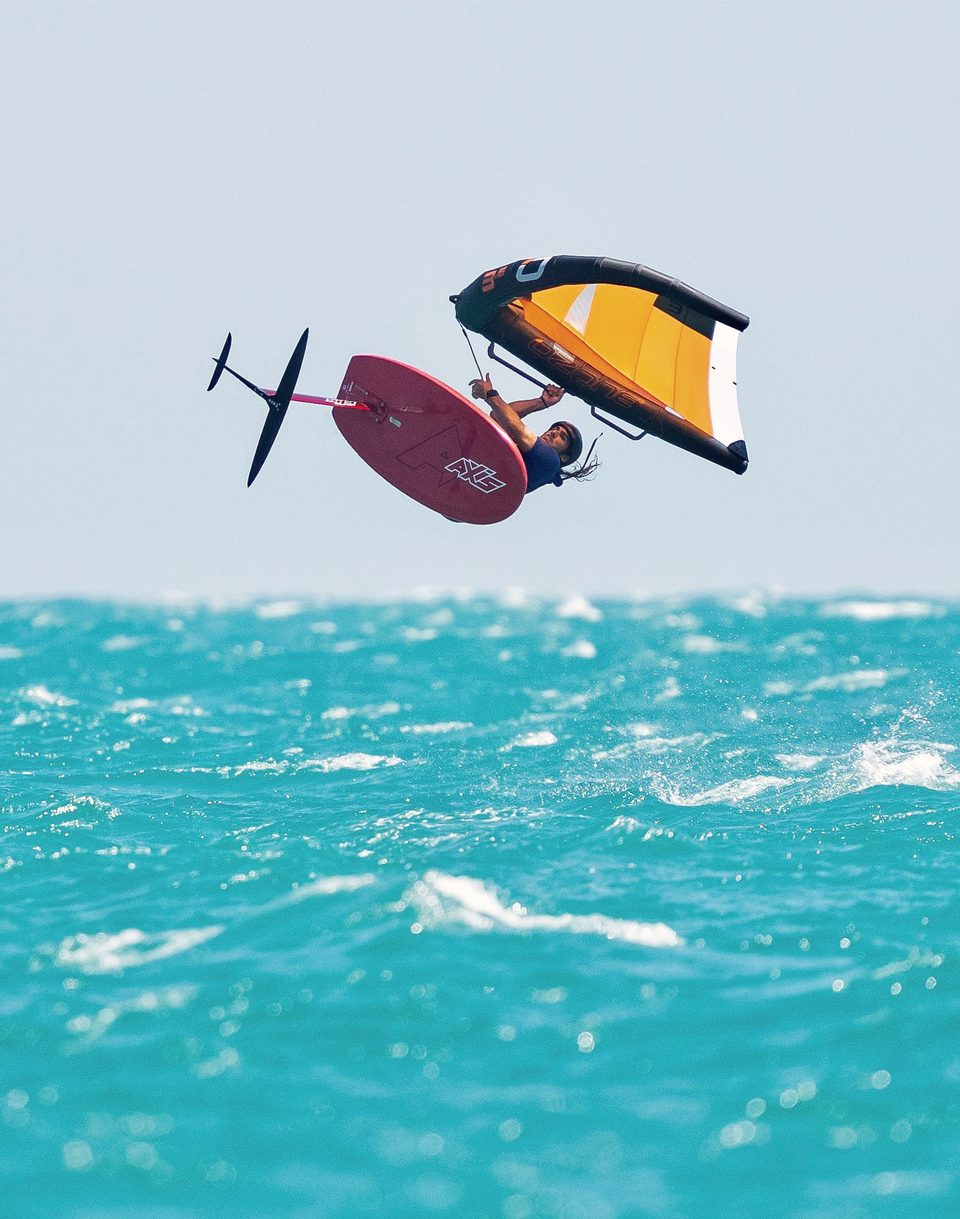
You get it fast enough that the foil does. Every beginner tries to muscle the board into the air with the wing, and every beginner discovers that pulling harder produces a nose-dive rather than a take-off. Build speed, then let it happen.
Pumping is a rhythm
Wing and body together, loading and unloading, finding a frequency that adds speed rather than one that scrubs it off. It looks energetic and it is not; a rider who is fighting is a rider who has not found the rhythm yet.
Come down on purpose
Sheet out a little, ease the front foot forward, and set the board back on the water. Learn this in the same session you learn to go up. A rider who can only take off is a rider whose flights all end in a fall, and Chapter 21 has the numbers on what falls cost.
Where this sits, and the disagreement again
IKO puts “pumping / getting on the hydrofoil” at skill nine of fourteen, in one continuous ladder. The RYA makes it an entire course, First Flights, gated behind two complete wingsurfing courses. C2SKY’s published outcome puts “your first time up on the foil” at the four-hour rung.
HEIGHT CONTROL
You fly in a band, not at a height. Both ends of it drop you.
WHAT YOU WILL BE ABLE TO DOSay what happens at each end of the height band, and why the corrections are small and early.
The first flight is a threshold. The second problem is staying on the useful side of it, and it is a completely different skill.
Too low
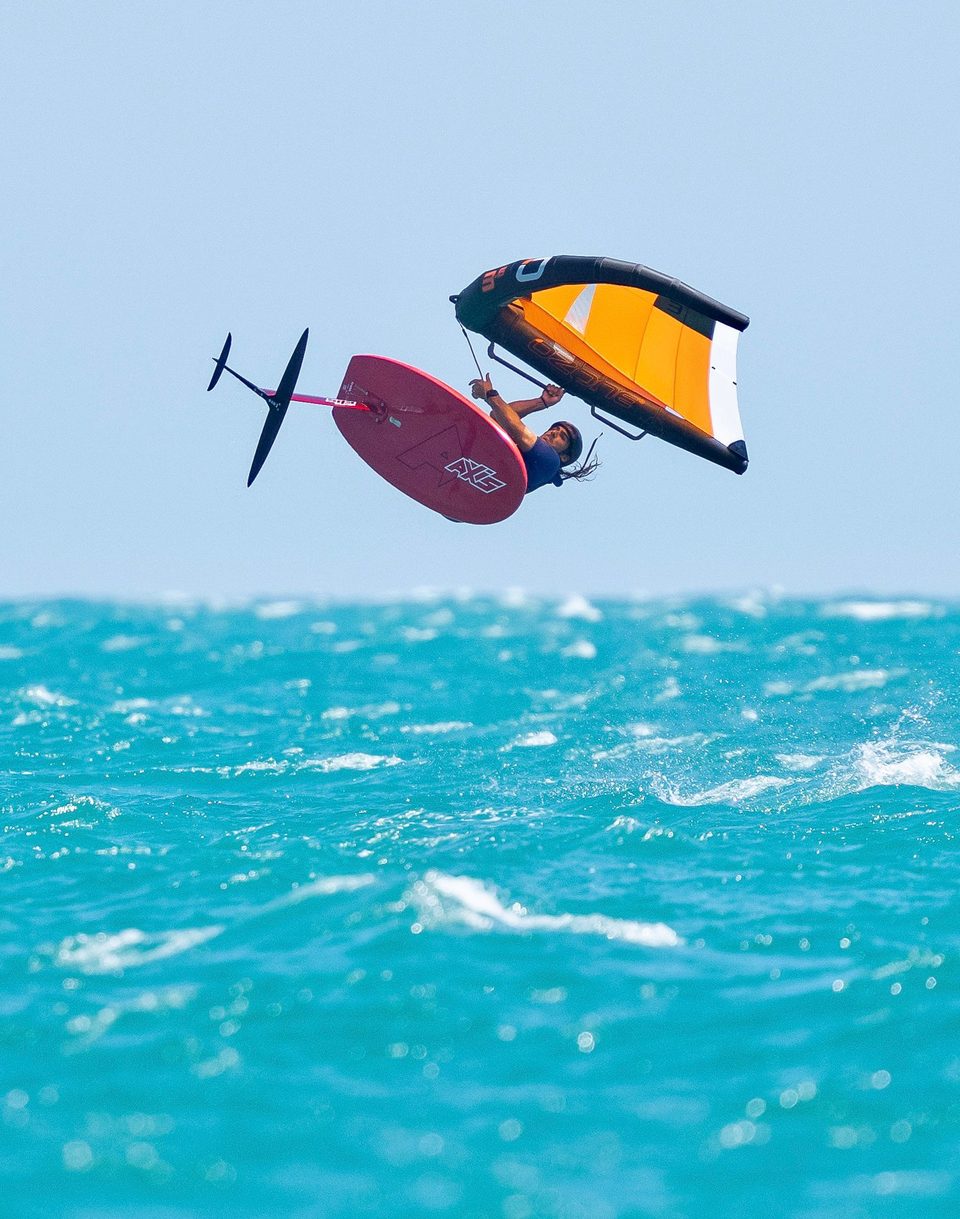
The board touches the water, drag arrives instantly, and the flight ends. Cheap, undramatic, and the way most early flights finish.
Too high
The foil approaches the surface, air reaches it, and lift disappears. You fall from the top of the mast with the board and the foil above you. This is the expensive end of the band, and it is the one worth being disciplined about.
The two controls
Front-foot pressure and the sheeting hand, together, in small amounts. Push the front foot down slightly and the nose drops. Sheet in and you accelerate, which generates more lift, which raises you. They interact, and learning them as one control rather than two is the content of this chapter.
Mast length changes the stakes
The RYA’s teaching standard is a mast below 85 cm for first flights. A short mast makes the band narrower, so you find its edges sooner — and it makes the top of the band much closer to the water, so finding it costs less. That is a deliberate trade in your favour.
SUSTAINED FLIGHT
Both directions, and the wind you are sheeting against is no longer the wind that is blowing.
WHAT YOU WILL BE ABLE TO DOSay what changes between a first flight and a ride, and use apparent wind rather than being surprised by it.
C2SKY’s published outcome for its six-hour course is “sustained flight in both directions”, and the second half of that phrase is the harder half.
Apparent wind is now doing the work
You met it in Chapter 10. Now it matters constantly. As you accelerate, the wind you feel swings forward and strengthens, so the wing that felt right at rest is sheeted wrong at speed. The correction is almost always to ease out as you build speed, not to pull in harder.
Both directions is a second sport
Almost everybody has a strong side. On the weak side the wing is in the other hand, the foot forward is the other foot, and the balance point feels wrong. It is trained deliberately or it never arrives, and it does not arrive by itself no matter how many hours you do on the good side.
The marginal-wind trap
Fatigue, with numbers
Sustained flight is when sessions get long, and the one study of the sport has something to say about long sessions. Riders attributed 77.5 % of their injuries to riding errors when tired — that is what the injured riders said caused it, not something the study measured. What the study did count is when: 24 % of injuries in the first hour on the water, 55 % in the second, 21 % later. Those two things point the same way, and the second hour is plausibly the hour in which you are tired and confident at the same time.
GOING UPWIND
The difference between a session and a walk.
WHAT YOU WILL BE ABLE TO DOSay what upwind riding requires, and why it is the skill that turns a rider into an independent one.
Until you can go upwind, every session ends downwind of where it started and the last part of it is on foot. Upwind is the skill that ends that, and it is the skill schools use to define independence.
Three things at once, all of them small
- Pointing. Steer the board higher, up to the edge of the no-go zone, without stalling the wing.
- Foil efficiency. A settled, level ride loses less than a bouncing one. Upwind rewards smoothness rather than effort.
- Wing angle. Sheeted to keep driving at the higher angle, which is a finer setting than you have been using.
The foil is already doing part of it
An immersed foil resists sideways drift far more than a fin. That is why a foiler points higher than a windsurfer on the same water, and it is why upwind on a foil is a technique problem rather than an equipment problem.
Downwind is the half people forget
IKO lists them as one skill — “ride upwind/downwind” — and it is right to. Going downwind you catch the wind up: your speed subtracts from the true wind, the apparent wind collapses, and the wing goes soft at exactly the moment you have the most speed. It feels like the wing has failed. It has not; you have run away from it.
TURNING ROUND
Jibe first, tack second, and while you are turning you are the one who gives way.
WHAT YOU WILL BE ABLE TO DOTell a jibe from a tack, know which comes first and why, and place both on the map.
There are two ways to change direction and every published progression teaches them in the same order, for a reason that is entirely about speed.
The jibe turns through the fast part
A jibe is the downwind turn. You carry speed all the way round, so the foil keeps flying, so you keep the option of correcting anything. This is why it is first.
The tack turns through the slow part
A tack goes upwind, through the no-go zone, and there is a moment in the middle with no drive at all. A foil does not forgive a moment with no drive: below take-off speed it stops being a wing and becomes a lot of drag. This is why it is later, and why it is on the far side of Gate 4.
The foot change is its own skill
IKO lists it separately, at skill eleven, before either turn — because changing which foot is forward while flying is hard enough to be worth learning on its own. A first jibe usually keeps the feet where they are; the foot-change version comes later.
A stopped turn is a legitimate stage
Coming off the foil, turning round on the water, and going again is not a failed jibe. It is the version of the skill you can do now, and it is exactly what you were doing in Chapter 14 — which is why Chapter 14 was worth the time.
What is past this
Tacks, foot-change jibes, riding swell, downwinders and jumps are Gate 5. They are named here so you know where they sit, and they are not taught in this guide.
FALLING
You will fall many times per session for weeks. The whole point of this chapter is that all of them are cheap.
WHAT YOU WILL BE ABLE TO DOSay what the evidence shows about how wingfoilers get hurt, and describe how to fall away from a foil.
Falling is the normal case in this sport, not the failure case. Nobody learns to fly without coming down badly a great many times, and there is nothing to be gained from pretending otherwise. What is worth knowing is exactly what does the damage, because it is not what most people assume.
What actually hurts wingfoilers
There is one published study: 415 riders, twelve months, 356 injuries. Its findings on mechanism are unusually clear.
- Your own equipment — foil and mast 25.9 %, board 20.2 %, wing 7.0 %.
- 99.15 % of it happened on the water, not on the beach.
- Not one injury was caused by contact with another water user.
- 77.5 % were riding errors that the injured riders themselves attributed to being tired. That is the one figure on this list that is an opinion rather than a count.
And when
Twenty-four per cent in the first hour, fifty-five in the second, twenty-one later. And the rate falls as experience rises: 37 % of beginners were injured over the year, 34.6 % of advanced riders and 22.6 % of experts. That is a statistically significant association (p = 0.026) — the trend is real in the data. It is not proof that getting better is what protects you: experts may also ride different water, in different conditions, and stop earlier. The study did not separate those.
And where, on you
How to fall
No training body and no manufacturer in our source register publishes a falling procedure, so what follows is a principle rather than a drill, and it is the thing to rehearse with an instructor in water you have checked.
- 01
Recognise it early and stop trying to save it.
A save you were never going to make turns a flat fall into a fall onto the equipment. The riders who get hurt are usually the ones who fought.
COMMON MISTAKETwo extra seconds of trying, which is exactly enough to end up on top of the foil.
- 02
Go away from the board, wide and flat.
Not down. Feet out to the side rather than straight beneath you, and as much of you on the surface as possible.
COMMON MISTAKELanding feet-first, which is how a foot finds a stabiliser.
- 03
Cover your head and surface with your arms up.
The board and the foil keep moving after you stop. That is F-One’s own warning, and the moment after the fall is the moment you cannot see them.
COMMON MISTAKEStanding straight up under a board that is still travelling.
Foot straps, honestly
Straps caused 6 % of knee injuries and 24 % of ankle injuries, by holding the foot while the rest of the rider went round. The paper’s authors, who are trauma surgeons, note that the obvious answer — a strap that releases only in a fall — has not been built. You do not need straps to learn.
Helmets and vests, more honestly still
Eighty per cent of riders in the study used some protective equipment; of those, 91.3 % wore helmets and 71.2 % impact vests. Comparing them against the riders who wore none, the study did not detect a significant difference in head injuries (p = 0.763) or in chest injuries (p = 0.881).
SELF RESCUE
Your board is a raft. That single fact is the biggest safety advantage this sport has, and it is worth arriving knowing it.
WHAT YOU WILL BE ABLE TO DOKnow what a wingfoil self-rescue depends on, and understand that reading this is not the same as having done one.
Naish makes it a precondition of going on the water: “Make sure you know on the water self-rescue techniques before using this product.” IKO makes it skill five of fourteen — before the rider ever gets on the foil. Both are telling you the same thing about when to learn it.
The board floats, and it floats you
A wing board has the volume of a small paddleboard. Unlike a kiteboard, it will carry you, and it will carry you for a long time. Do not separate from the board. Everything else in this chapter is negotiable and that is not.
The wing is floating and it is also a sail
While it is inflated it holds you up, and it also catches wind. Those two facts are in tension, and which one matters depends entirely on which way you need to go. That is the decision this chapter is really about.
Three broad options
No source in our register publishes a wingfoil self-rescue procedure, so this guide does not print one. What it prints is what decides between them:
- Use the wing. If the beach is downwind, sheet a little and let it take you in, slowly and under control. This is the best case and it is why cross-onshore is the good direction.
- Neutralise the wing and paddle. If the beach is across the wind, the wing becomes something you keep with you and stop using, and the board becomes a paddleboard.
- Make the wing into cargo. Depower it, secure it to you or to the board, and paddle. Slower, and sometimes the only option.
The foil, while you paddle
It is drag, and it is under you the whole way. It is also something solid to hold. What it is not is a reason to take the board apart in deep water.
Signal, and signal early
Cabrinha requires that somebody knows where you have gone and when you are expected back. Both Cabrinha and F-One require that you do not go alone. A self-rescue that starts when you first realise you have a problem is a long paddle; one that starts when you are exhausted is something else.
The eight rules that mean you never need any of this
- Never further from shore than you can swim back.
- Never alone, and somebody knows when you are due.
- Never in offshore wind.
- Never in wind above your ability, or wind that is about to change.
- Never where a single component breaking would leave you unable to return unassisted — that is Cabrinha’s wording, and it is a good test.
- Keep a reserve of energy. Finish before you are tired.
- Know what is downwind of you before you go out.
- Come in when the conditions change, in either direction.
RIGHT OF WAY
There is exactly one published wing right-of-way code in the world, and these are its rules.
WHAT YOU WILL BE ABLE TO DOApply the right-of-way rules in the four encounters you will actually meet.
The rules below come from the GWA Wingfoil World Tour Rulebook. It is a racing document, and that is not a weakness: racing is where the sailing conventions had to be written down precisely for wings, and nobody else has written them down at all.
The four you need
- Opposite tacks: the port-tack rider keeps clear of the starboard-tack rider. (19.1.4)
- Same tack, overlapped: the windward rider keeps clear of the leeward rider. (19.1.5)
- Same tack, not overlapped: the rider clear astern keeps clear of the rider clear ahead. (19.1.6)
- One of you is on a wave: the rider going out keeps clear of the rider riding in. (19.1.3)
The two that catch beginners
Right of way is not a right to hit anybody
The rulebook is explicit. A rider must avoid contact where reasonably possible even with right of way (19.1.10). A rider acquiring right of way must initially give the other rider room to keep clear (19.1.11). A right-of-way rider changing course must give room (19.1.12). And a windward rider must not jump when a leeward rider is close (19.1.13).
What outranks all of it
These are racing rules. On open water, international collision regulations, national law and local spot rules come first, and every manufacturer manual says the same thing: observe local rules and regulations, and ask the locals what they are. A rulebook does not know that a particular channel is a boat lane.
WHEN NOT TO GO
The last skill to arrive, and the one that keeps the experienced riders in the low-injury column.
WHAT YOU WILL BE ABLE TO DOMake the decision not to ride, and know the conditions every source in the register agrees on.
Almost everything in this guide is about doing something. This chapter is about not doing it, and it is the chapter that separates riders who have been doing this for ten years from riders who did it for two.
The unanimous list
Every manufacturer manual in the register says all of these, in its own words:
- Thunderstorm or lightning — and leave the water immediately if one is approaching.
- Offshore wind.
- Wind above your ability level.
- Conditions that are likely to change dramatically.
- Alone.
- Under the influence of alcohol, drugs or medication.
- In poor physical condition, or unable to swim confidently.
Changing conditions, in both directions
Cabrinha’s instruction is to return to the beach if there is a significant change — “i.e. wind dropping or wind & waves increasing”. Dropping wind is as much a reason as rising wind, and on a foil it is the more dangerous of the two because the foil hides it from you until it is gone.
Fatigue is a condition
It is what injured riders blamed most often — 77.5 % of them — and the injury count peaks in the second hour on the water. Treat “I am tired” the way you would treat “the wind has doubled”: as a change in conditions that ends the session.
Forecast, measurement, and the honest answer
A model tells you what it expects; a station tells you what is happening. C2SKY keeps those two apart on every one of its own surfaces, and states plainly that when there is no measured reading to give you, you get the camera rather than an invented figure. Adopt the same standard for your own decisions.
CHOOSING YOUR OWN EQUIPMENT
Three decisions, three different authorities, and two of them disagree with themselves.
WHAT YOU WILL BE ABLE TO DOReason about a first purchase instead of copying a chart.
At some point you will buy your own. This chapter is not a shopping list; it is a way of reading the ones you will find.
The wing
Beginner range 2.8 to 4 square metres, per the RYA. Manufacturer size-and-wind tables exist and are useful, and their authors describe them as “a rough guide only” with a one-size adjustment for a significantly heavier or lighter rider. Cabrinha’s rule for doubt: choose smaller rather than bigger.
The board
IWO’s published rule of thumb is your weight in kilograms plus forty, in litres. IWO’s own published level bands are wider than that and overlap it. Both are on the same page of the same article. Take the formula as a starting point and the bands as the honest error bar.
The foil
Big front wing, low aspect ratio, short mast. The RYA’s teaching guidance for centres is a front wing over 700 cm² and a mast below 85 cm for first flights; IWO says masts of 65 to 75 cm are the most used. Bigger area means earlier flight in less wind, and a lower top speed you will not miss for a year.
The leash
A wing leash with a quick release, without exception. For the board leash, read Chapter 07 and then ask the person who knows your conditions.
Protection
Helmet and impact vest. Chapter 21 sets out exactly what the evidence does and does not show, and every manufacturer and the sport’s association recommend or require them regardless.
WINGFOILING IN MUI NE
A monsoon, a sea breeze, two beaches and one honest gap.
WHAT YOU WILL BE ABLE TO DOArrive knowing what the wind does here, when the season is, and exactly which local facts this guide will not invent.
Mui Ne works for wind sports for a reason that is physical rather than promotional, and it is worth understanding before you book.
The mechanism
The northeast monsoon sets the season. On top of it sits a coastal afternoon thermal sea-breeze enhancement — the land heats, the air over it rises, and air comes in off the sea to replace it. That is why the wind is an afternoon phenomenon here, and it is why a morning that looks hopeless is not evidence about the day.
The curve above is derived from 3 808 hours of reanalysis over season afternoons at C2SKY’s verified coordinate: 3.6 knots at five in the morning, 11.4 knots at three in the afternoon, 8.7 by six. Direction is robust — a vector mean of 105°, with seventy per cent of the hours from the eastern quadrant.
The season
Roughly October to the end of April for wing, which starts a little earlier than the kite season. May to September is the Mui Ne monsoon: weather, not a marketing failure.
Two beaches
Wing does not happen at the kite beach by default. C2SKY uses a separate flat-water spot, about twenty minutes away, described in the school’s own words as “shallower and calmer than the kite beach, and a different place entirely” — and elsewhere as “more open water, deeper sooner, better for foiling”.
Both descriptions are true and the combination is exactly what a foil beach needs: flat water, which the RYA wants for teaching, and a bottom that reaches foil depth without a long wade, which F-One’s entry rule requires. Which spot a given session runs from is decided on the day, on the wind.
The tide
Derived range about 2.6 metres. That is a material tide for a shallow teaching beach: it moves the waterline, it changes the depth where the lesson happens, and it covers and uncovers whatever is on the bottom. Chapter 03 is the reason that matters more here than it would to a windsurfer.
What this guide will not tell you, and why
THE PROGRESSION MAP
Five gates, two published syllabuses and one price list, laid over each other.
WHAT YOU WILL BE ABLE TO DOLocate yourself on the gates, and understand what C2SKY’s hours do and do not buy.
Three organisations describe this journey and none of them describes it the same way. Here they are together.
The gates, restated
| GATE | YOU ARE THROUGH IT WHEN |
|---|---|
| G0 · BEFORE YOU ARRIVE | You can read a forecast, name the kit, and say what a foil is and why it is sharp. |
| G1 · THE WING | You can hold, sheet, flag and park a wing on land, walk with it, and secure it. |
| G2 · THE BOARD | You can get in and out with a foil, ride on your knees, stand, taxi, steer — and come back to where you started. |
| G3 · FLIGHT | You can get onto the foil, hold a height, fly sustained in both directions, and come down on purpose. |
| G4 · INDEPENDENCE | You can hold ground upwind, turn without stopping, apply the rules in traffic, self-rescue in deep water, and decide not to go out. |
| G5 · AFTER | Tacks, foot-change jibes, swell, downwinders. Named here, taught elsewhere. |
A gate is passed by demonstrating something, not by spending an hour.
C2SKY’s ladder, exactly as published
| HOURS | COURSE | DAYS | PUBLISHED OUTCOME |
|---|---|---|---|
| 2 | Intro to Wing | 1 | Wing handling and your first runs on the board |
| 4 | Taster | 1–2 | Your first time up on the foil |
| 6 | Wind Runner | 3 | Sustained flight in both directions |
| 9 | Aero | 4–5 | Independent wingfoiling |
| 12 | Full Throttle | 6 | — |
| 15 | Master Wing | 7–8 | — |
| 18 | Supreme | 8+ | — |
One-to-one private is the only published variant. Three rungs carry no published outcome and this guide does not write one for them — they are continued work at Gate 4 and into Gate 5.
Where the bodies disagree, and it matters
IKO puts self-rescue at skill five and right of way at skill six — before the rider ever gets on the foil. This guide’s gates put both at G4. Both are defensible and they are answering different questions: IKO is ordering what gets taught, and the gates describe what has been demonstrated. Read Chapters 22 and 23 early. Expect to prove them late.
What a lesson price covers
In the owner’s own words, confirmed in writing: “Every lesson price covers the instruction and all the equipment you need for that lesson.” And if the wind fails: “No suitable wind: we reschedule, and you pay only for the hours you complete.” That is a commitment about payment and an undertaking to try on rescheduling. It is not a money-back guarantee and this guide does not present it as one.
THE INDEPENDENT WINGFOILER
Eighteen things you can either do or not do. Nothing on this list is a feeling.
WHAT YOU WILL BE ABLE TO DOMeasure yourself against a checklist rather than against an hour count.
Independence is not a card and it is not a number of days. It is a set of demonstrations, and this is the set. Every line traces back to a chapter, and the last one is on the list because the evidence puts it there.
0 OF 18 CONFIRMED
- IW-01
- IW-02
- IW-03
- IW-04
- IW-05
- IW-06
- IW-07
- IW-08
- IW-09
- IW-10
- IW-11
- IW-12
- IW-13
- IW-14
- IW-15
- IW-16
- IW-17
- IW-18
What a school means by it
C2SKY’s published gate for renting kite equipment is that you can ride upwind, self-rescue and pack down alone, with a short check on the water to settle it either way. Whether the wing gate is worded identically is not recorded in this project — but if it is, everything it names is on the list above.
GLOSSARY
Every word in this guide, in the form your instructor will say it.
WHAT YOU WILL BE ABLE TO DOLook anything up.
Assembled from the manufacturers’ own parts diagrams and glossaries, IKO’s skill names and the GWA’s rule definitions. The definitions are written fresh; none is reproduced.
The wing
| TERM | WHAT IT MEANS |
|---|---|
| Leading edge | The inflated front tube. The wing’s spine, and the reason it floats. |
| Strut | The inflated centre spine running back from the leading edge. Carries the handles or boom. |
| Canopy | The cloth between the tubes. Where the force comes from. |
| Window | The transparent panel you look through. Never folded. |
| Luff panel | The section of canopy nearest the leading edge, on some designs. |
| Flagging handle | The handle nearest the leading edge. Held alone, the wing weathervanes and depowers. |
| Sheeting | Pulling the back hand in or letting it out, to increase or reduce power. Continuous, not a switch. |
| Neutral position | Wing held overhead. Least drive — and on land, the position from which riders get lofted. |
| Neutral zone | The sector around and above you where the wing produces least power. Your pause button, on the water. |
| Lofting | Being lifted off the ground by a gust with the wing overhead. The land hazard. |
| Luffing | What the canopy does when it loses its shape in a lull. |
| Lull | A drop in wind strength, for any length of time. |
| Overpowered | A wing too powerful for the rider’s ability, weight, strength or the conditions. All four count. |
| Wing leash | The line connecting you to the wing. Always worn, and it must carry a quick release. |
The board and the foil
| TERM | WHAT IT MEANS |
|---|---|
| Volume | The board’s flotation, in litres. Flotation is learning time. |
| Mast track | The slot the foil bolts into, and how far forward or back it sits. |
| Mast | The vertical part of the foil. Sets how deep it runs and how high you can fly. |
| Fuselage | The horizontal spine holding the two wings at a fixed distance and angle. |
| Front wing | The large lifting surface. Bigger area, earlier flight, lower top speed. |
| Stabiliser | The small rear wing. Holds the attitude, and it is the part feet find. |
| Aspect ratio | Span against chord. Low aspect is stable and lifts early; high aspect is fast and unforgiving. |
| Surface area | The front wing’s area in cm². It sets your take-off speed. |
| Take-off speed | The speed at which the foil’s lift equals your weight. A threshold, not a ramp. |
| Ventilation | Air reaching the foil from the surface. Lift collapses and you fall from the top of the mast. |
| Breach | The foil coming out of the water entirely. |
| Porpoising | An oscillation up and down, caused by corrections that are late and large. |
| Board leash | The line connecting you to the board. Conditional — see Chapter 07. |
Wind, water and traffic
| TERM | WHAT IT MEANS |
|---|---|
| True wind | The wind that is blowing, measured by somebody standing still. |
| Apparent wind | True wind combined with your own motion. What you actually sheet against. |
| Onshore / offshore | Blowing from the water toward the land, or from the land out to the water. |
| Cross-shore | Blowing along the beach. Cross-onshore is the angled, onshore-leaning version, and it is the good one. |
| Taxiing | Riding on the water with the foil loaded but not lifting. |
| Holding ground | Finishing where you started. Not progress upwind — no loss. |
| Tack (the manoeuvre) | Turning upwind, through the no-go zone. Learned after the jibe. |
| Jibe / gybe | Turning downwind, through the powered part of the arc. Learned first. |
| Transition | Any change of direction. While in one, you are the rider who keeps clear. |
| Starboard tack | Wind coming over your right side. Has right of way over port. |
| Windward / leeward | The side toward the wind, and the side away from it. Windward keeps clear. |
| Overlapped | Two riders whose positions overlap when projected across their line of travel. |
| No-go zone | The arc too close to the wind for the wing to drive you. |
| Broad reach | Angled downwind of across. The fastest point of sail, and where every first ride goes. |
Certification
| TERM | WHAT IT MEANS |
|---|---|
| IKO | International Kiteboarding Organization. Publishes a fourteen-skill wing foil course as Level 5 · Winging. |
| IWO | International Wingfoil Organization, founded in 2022 by IKO. Certifies wingfoil instructors and centres. |
| RYA | Royal Yachting Association. Publishes a four-stage Wing scheme, and the foiling guidance its centres teach to. |
| GWA | Global Wingsports Association. Publishes the sport’s only right-of-way code, in its competition rulebook. |